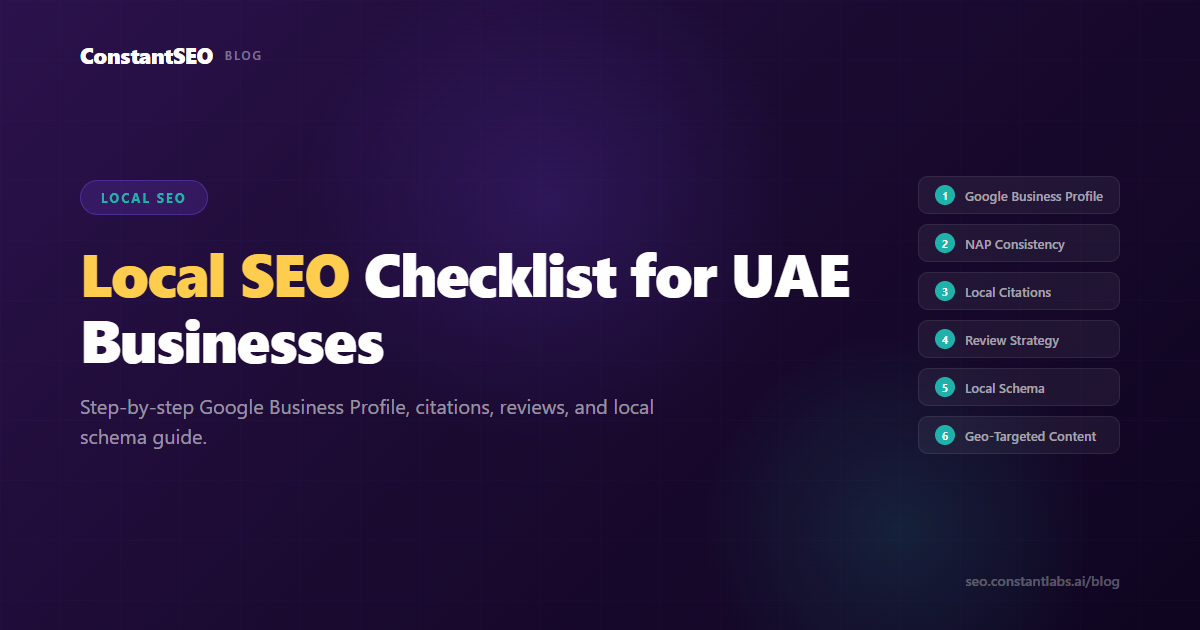
A practical, step-by-step checklist for UAE businesses to dominate local search. From Google Business Profile optimization to citation building and review strategy, this guide covers every action item you need.
Why Local SEO is Critical for UAE Businesses
Local search drives a disproportionate amount of high-intent traffic for businesses in the UAE. When someone searches for "dentist near me" or "best shawarma Dubai Marina," they are ready to take action, whether that means calling, visiting, or booking online. These high-intent local searches represent the most valuable organic traffic your business can capture.
The UAE presents unique local SEO dynamics. The country is geographically compact but commercially dense, with distinct business hubs that each have their own search ecosystems. Dubai alone has dozens of distinct neighborhoods, from Downtown and Marina to Deira and Al Quoz, each generating location-specific search queries. Abu Dhabi, Sharjah, and the Northern Emirates add further geographic layers.
Google's local search algorithm weighs three primary factors: relevance (how well your listing matches the search query), distance (how close your business is to the searcher), and prominence (how well-known and trusted your business is online). The checklist that follows is structured around maximizing all three of these factors for UAE businesses.
Google Business Profile Optimization Checklist
Your Google Business Profile (GBP) is the single most important asset for local SEO. Here is the complete optimization checklist. Claim and verify your listing if you have not already. Choose the most specific primary category available ("Thai Restaurant" beats "Restaurant"). Add all relevant secondary categories, up to 10 total. Write a complete business description using natural keyword placement, filling the full 750 characters.
Add your complete business information: exact business name (no keyword stuffing), street address, phone number (local UAE number with +971), website URL, and business hours including holiday hours. Upload at least 25 high-quality photos: exterior, interior, team, products or services, and atmosphere shots. Google reports that businesses with photos receive 42% more direction requests and 35% more website clicks.
Enable messaging and add your services or products with descriptions and prices in AED. Create a Google Business Profile post at least once per week. Posts can announce offers, share updates, or highlight services. Enable the Q&A section and proactively add common questions with answers. Set up the booking button if applicable, linking to your appointment scheduling system. Keep your listing updated constantly because GBP is a living asset, not a set-and-forget profile.
NAP Consistency Across All Platforms
NAP stands for Name, Address, and Phone number, and consistency across every online mention of your business is a foundational local SEO signal. Google cross-references your business information across the web, and discrepancies create confusion that can hurt your rankings.
Start by establishing your canonical NAP format. Decide on the exact business name you will use everywhere (include or exclude LLC/FZE/FZ-LLC consistently), the exact address format (decide on abbreviations, suite numbers, building names), and the phone number format (+971 4 XXX XXXX or 04 XXX XXXX, pick one). Document this as your official NAP and ensure every team member uses it.
Audit your existing online presence for NAP inconsistencies. Check your website, Google Business Profile, social media profiles (Facebook, Instagram, LinkedIn), directory listings, and any other platforms where your business appears. Common sources of inconsistency in the UAE include using P.O. Box numbers versus physical addresses, having outdated phone numbers on old directory listings, and using different trading names versus legal names across platforms. Tools like BrightLocal or Whitespark can help automate this audit, but manual checking of UAE-specific directories is also necessary.
Building UAE-Specific Citations
Citations are online mentions of your business NAP on third-party websites. They act as trust signals for Google's local algorithm. For UAE businesses, focus on both general international directories and UAE-specific platforms.
Priority UAE directories to list your business on include: Yellow Pages UAE (yellowpages-uae.com), Bayut (for real estate and related services), ServiceMarket, Dubizzle, ConnectME, UAE Business Directory, CyberSearch UAE, and Gulf News classifieds. For industry-specific directories, identify the top platforms in your sector. For example, restaurants should be on Zomato, TripAdvisor, and TimeOut Dubai. Healthcare providers should be on Practo and DHA's (Dubai Health Authority) provider directory.
Beyond directories, look for citation opportunities on UAE Chamber of Commerce listings, free zone directories (DMCC member directory, DAFZA directory), industry association websites, and local event sponsorship pages. Each citation should use your exact canonical NAP format. Build citations gradually rather than all at once, as a sudden spike in citations can appear unnatural. Aim to add 5 to 10 new quality citations per month during your initial build-out phase, then maintain and monitor them quarterly.
Review Strategy: Getting and Managing Google Reviews
Reviews are one of the strongest local ranking factors and play a huge role in conversion rates. In the UAE market, where word-of-mouth and reputation carry significant cultural weight, a strong review profile can be a decisive competitive advantage.
Set a target for review quantity and quality based on your competition. Search your primary keywords and check how many reviews the top-ranking businesses have. In many Dubai categories, the top performers have 100 to 500+ reviews with ratings above 4.5 stars. Your goal is to match or exceed the review count and rating of your top three competitors.
Create a systematic review generation process. The most effective approach is to ask for reviews at the point of peak satisfaction, typically right after a successful service delivery or purchase. Use direct links to your Google review page in follow-up emails, SMS messages (with the customer's consent), and WhatsApp messages. WhatsApp is particularly effective in the UAE because of its near-universal adoption. Respond to every review, positive and negative, within 24 to 48 hours. Thank positive reviewers specifically for what they mentioned. For negative reviews, respond professionally, acknowledge the issue, and offer to resolve it offline. Never argue publicly or offer incentives for review changes.
Local Schema Markup Implementation
Schema markup helps search engines understand your business information in a structured format. For local SEO in the UAE, several schema types are particularly important and should be implemented on your website.
LocalBusiness schema (or a more specific subtype like Restaurant, DentalClinic, or LegalService) should be on every page of your website. Include your name, address (with both streetAddress and addressLocality set to your Dubai/Abu Dhabi area), postalCode, telephone, openingHoursSpecification (with each day spelled out), geo coordinates (latitude and longitude of your exact location), priceRange, and areaServed.
Add AggregateRating schema once you have sufficient reviews to display. Implement FAQ schema on service pages where you answer common questions. If you serve multiple locations, use multiple LocalBusiness schema entries, one for each location, linked via a parent Organization schema. For service-area businesses without a storefront (like mobile car wash or home cleaning), use the areaServed property to specify your coverage zones rather than listing a physical address. Validate all schema using Google's Rich Results Test tool before deploying to ensure there are no errors that could prevent rich results from appearing.
Geo-Targeted Content and Internal Linking
Creating location-specific content for the areas you serve is one of the most effective local SEO tactics for UAE businesses. Rather than a single generic "Services in Dubai" page, create dedicated pages for each major area where you operate.
For example, a cleaning company in Dubai should have separate, unique pages for Dubai Marina, Downtown Dubai, JBR, Business Bay, Palm Jumeirah, Arabian Ranches, and every other community they serve. Each page should include unique content about serving that specific area, reference local landmarks and characteristics, embed a Google Map centered on that location, include area-specific testimonials if available, and display relevant NAP information.
The key is making each location page genuinely unique and useful rather than just swapping out the neighborhood name in a template. Mention specific buildings, local knowledge about access or parking, and any area-specific service considerations. Internal linking between these location pages, your main service pages, and your blog content creates a strong topical and geographic signal that reinforces your local relevance. Build a hub-and-spoke model where your main service page links to all location variants, and each location page links back to the service hub and to related blog content.